This short chapter provides the evidence needed to sway the skeptic to reason. There has never been a lack of evidence for believing in the validity of the Holy Bible’s historical record. What is lacking, however, is the skeptics’ willpower to accept the facts presented. As factual as the information is, the skeptics do not want to believe… therefore, they maintain their willful ignorance.
Putting aside the miracles it claims (for now), the Holy Bible is in fact a legitimate history book. Many of the people, places, trials and tribulations faced by those recorded in its pages have been catalogued in the archaeological record. Those refusing to “believe” this evidence are simply denying reality.
Skeptics hate defending the topic of archaeology as it interferes with their emotional state of denial. For this reason, presenting the facts regarding archaeology as the first point of debate is key. Command their attention away from their “feelings” about the “religion” of the Bible. Love them or hate them, the facts are the facts.
Below is a list of archaeological discoveries you can provide any skeptic claiming the Bible is not a valid historical document.
The Discovery of Hezekiah’s Tunnel
The Siloam Tunnel was built under the command of King Hezekiah during the Assyrian siege of Jerusalem circa 701 BC. This account is recorded in the book of II Chronicles 32, II Kings 20, and Isaiah 22:9-11.
Many wars have been fought in Jerusalem. Her history is riddled with violence and destruction, leaving its once standing stone structures, houses, and various fortified walls buried under piles of earth and rubble. The ancient waterway known as the Siloam Tunnel (or Hezekiah’s Tunnel) was abandoned 150 feet below the surface of the City of David and forgotten under the ruins of history. Many centuries would pass, and many explorers would navigate the new cities built atop the old ruins. One of these entrepreneurial spirits was Franciscus Quaresmius in the year 1625.
Franciscus was an unofficial emissary of sorts to the Holy Land serving under the Popal office. He commissioned many other works, but to this point, he was the first to document the finding of the Siloam Tunnel in modern times.
It was later explored in 1838 by Edward Robinson, who became the first person to traverse the length of the underground tunnel. Additionally, the tunnel was rediscovered by Charles Warren in 1865. Later, in 1871, Warren suggested the Pool of Siloam, connected to the tunnel, may have been constructed by Hezekiah. Each of these discoveries contributed significantly to the understanding of the tunnel’s historical importance and its association with King Hezekiah of Judah.
Later still, in 1880, a sixteen-year-old boy named Jacob Eliahu working under the tutelage of Conrad Schick, a renowned architect and researcher in Jerusalem, literally stumbled across the now infamous inscription proving the origins of this man-made underground waterway.

The young boy was excitedly navigating the pool when he slipped on a mossy rock, falling into the deeper waters. Upon rising from his fall, his eye caught light cast upon what appeared to be a Hebrew inscription covered partially by salt deposits and mossy residue.
After brief examination, Jacob returned to his mentor with the news of his discovery. Schick would immediately investigate the find himself. After extended scrutiny, Schick brought the details of the engraved inscription to the world’s attention.
According to scholars, the best translation of this inscription is as follows.
“While [the stonecutters were swinging] the axe one toward the other, and while there were still three cubits to be cut th[rough, there was hear]d the sound of one calling to the other, for there was a zdh in the rock on the right and on the [le]ft. And on the day of the cutting-through, the stonecutters were hewing each toward the other, axe upon [a]xe. And the water flowedfrom the outlet to the pool for one thousand [and t]wo hundred cubits. And one hu[nd]red cubits was the height of the rock over the heads of the stonecutter[s].”

The Armstrong Institute of Biblical Archaeology once wrote about this inscription suggesting it may have been the record of a tragedy during the construction, honoring the lives of those who perished during the dig. [i]
The Institute claims through interpretation of biblical text, as well as the inscription in the cavern, a catastrophic failure of the temporary dam which was built to halt the waters of the Gihon spring resulted in the underground Siloam tunnel being flooded while the workers were still inside. The “zdh” being the Hebrew explanation used often in biblical text for the point of “boiling over” or a “filled with passion/rage” type of statement. And therefore, as the Judean workers were digging this tunnel in haste during the inevitable siege of Jerusalem by the forces of King Sennacherib of Assyria, the dam burst forth, drowning the workers. Hence, the engraved tribute to the fallen workers during a time of great tribulation in ancient Israel.
Others more prominently claim this is simply a description of how the stone cutters accomplished the task of building the tunnel before the siege. In either case, what is more striking, is the precise description of the location of this tunnel in the bible, written roughly 2000 years prior to its discovery in 1625.
“And when Hezekiah saw that Sennacherib was come, and that he was purposed to fight against Jerusalem, 3He took counsel with his princes and his mighty men to stop the waters of the fountains which were without the city: and they did help him. 4So there was gathered much people together, who stopped all the fountains, and the brook that ran through the midst of the land, saying, Why should the kings of Assyria come, and find much water? …30 This same Hezekiah also stopped the upper watercourse of Gihon, and brought it straight down to the west side of the city of David. And Hezekiah prospered in all his works.” (2 Chronicles 32:2-4; 30)
The Bible records the exact location of the tunnel “down to the west side of the city of David” (see artist rendering page 6), and the date it was built. Explorers, not surprisingly, found that tunnel 2000 years later in the exact location as the bible explained, with an inscription in the Hebrew language written by its builders explaining the details of how it was built!
When the skeptic continues in their denial of the biblical text, for whatever reason, we simply point out that it is not only the Bible claiming this historical fact. We can point the naysayers to the clay documents of King Sennacherib himself.
The Sennacherib Prism (also known as the Taylor Prism) is a six-sided baked clay artifact standing roughly 15 inches tall, inscribed with Akkadian text in cuneiform script. It was discovered in the year 1830 by Colonel Robert Taylor of Britain in the city of Nineveh, near modern-day Mosul, Iraq. It came as no surprise to the believer, this ancient document dates to 700BC by secular scholars. Everyone agrees the Biblical account and the Taylor Prism account line up perfectly to the facts of history as well as the archaeological record.

Take therefore the words of King Sennacherib of Assyria, written in his own native tongue, in his own baked clay tablets, from his own time and country and read them to the skeptic.
“As for Hezekiah, the Judean, he did not submit to my yoke. I laid siege to 46 of his fortified cities, walled forts and to the countless small villages in their vicinity …. I led off 200,150 people, young and old, male and female, horse, mules, donkeys, camels, big and small cattle beyond counting, and counted them as booty.” (Sennacherib/Taylor Prism)
The details of this ancient war etched in hardened clay tablets created by the leader of the Assyrian empire echo the trails of the Judaean account.
“In the fourteenth year of King Hezekiah, King Sennacherib of Assyria marched against all the fortified towns of Judah and seized them. King Hezekiah sent this message to the king of Assyria at Lachish- “I have done wrong; withdraw from me; and I shall bear whatever you impose on me.” So the king of Assyria imposed upon King Hezekiah of Judah a payment of three hundred talents of silver and thirty talents of gold. Hezekiah gave him all the silver that was on hand in the House of the Lord and in the treasuries of the palace. At that time Hezekiah cut down the doors and the doorposts of the Temple of the Lord, which King Hezekiah had overlaid [with gold], and gave them to the king of Assyria.” (2 Kings 18-13-16)
The consistency in these two historical accounts is remarkable. No scholar on earth, neither secular nor biblical, would deny this fact. The Holy Bible as well as the Sennacherib Prism tell the same story!
Anyone claiming the bible cannot be trusted as a historical record is denying reality like an ostrich with its head buried in the sand, or a child plugging their ears singing, “la, la, la, la laaaa laaaa, iiiii am not liiiiisteniiiiing.”
You see, the Holy Bible is not a matter of belief …it is a matter of fact.
The Seals of Hezekiah and Isaiah
We opened this archaeological segment with a tunnel built by King Hezekiah. It seems fitting to now address his bulla as well.
A “bulla” is a clay stamp used for sealing documents. Traditionally, anyone with great significance such as a King, high priest, prophet or ambassador, would possess a ring with a unique symbol and phrase representing the authority they possess in said kingdom. When sending official documents of the state, they would roll up the scroll, use a small blot of clay to secure the edge of the fold then seal the clay by pressing their signet (the impression on the ring) into the doughy mixture. It would then harden, creating a seal. This ensured the recipient knew the document was in fact authoritative once the scroll arrived bearing an unbroken seal.
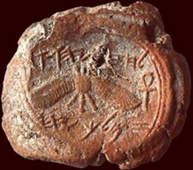
A team led by archaeologist Eilat Mazar excavating in the City of David, just outside the temple mount in Jerusalem, announced in December 2015 a discovery that would shock the world. On this bulla read a very clear seal.
Belonging to Hezekiah
Son of Ahaz
King of Judah

King Hezekiah was the most faithful King to rule in Judah second only to King David himself. No longer can the skeptic deny the reality of what we believers have known all along. The stories in the bible are not fairy tales to be told to children. These are real-life men of history. This archaeological find proves beyond the shadow of a doubt the existence of King Hezekiah and therefore validates many of the biblical books, including Chronicles and Kings.
Tremendous! What could be better proof than this? Well …what is an Old Testament King without his prophet? In a collection of more than thirty different bulla found in the same strata, during the same dig, in the City of David, was a bulla found bearing the seal of Isaiah, the prophet.

Video linked in endnotes. I would kindly ask the non-believer to please take your fingers out of your ears. This is not make-believe. This is hard evidence. [ii] And we have only just begun.
The Seals of Jehucal and Gedaliah
Such bulla’ have been found in mass. Like those that validate the life of the prophet Isaiah and King Hezikiah, are those that confirm the authenticity of the book of Jeremiah. Found in 2005, these two bulla show the seal of both Jehucal and Gedaliah. Princes in the court of ancient Judah.
“And Zedekiah the king sent Jehucal the son of Shelemiah and Zephaniah the son of Maaseiah the priest to the prophet Jeremiah, saying, Pray now unto the LORD our God for us. 4Now Jeremiah came in and went out among the people: for they had not put him into prison. 5Then Pharaoh’s army was come forth out of Egypt: and when the Chaldeans that besieged Jerusalem heard tidings of them, they departed from Jerusalem. …8And the Chaldeans shall come again, and fight against this city, and take it, and burn it with fire …15Wherefore the princes were wroth with Jeremiah, and smote him, and put him in prison in the house of Jonathan the scribe: for they had made that the prison. 16When Jeremiah was entered into the dungeon, and into the cabins, and Jeremiah had remained there many days;” (Jeremiah 37:3-5; 15-16)
“Then Shephatiah the son of Mattan, and Gedaliah the son of Pashur, and Jucal the son of Shelemiah, and Pashur the son of Malchiah, heard the words that Jeremiah had spoken unto all the people, saying, 2Thus saith the LORD, He that remaineth in this city shall die by the sword, by the famine, and by the pestilence: but he that goeth forth to the Chaldeans shall live; for he shall have his life for a prey, and shall live. 3Thus saith the LORD, This city shall surely be given into the hand of the king of Babylon’s army, which shall take it. 4Therefore the princes said unto the king, We beseech thee, let this man be put to death: for thus he weakeneth the hands of the men of war that remain in this city, and the hands of all the people, in speaking such words unto them: for this man seeketh not the welfare of this people, but the hurt.” (Jeremiah 38:1-4)
These two Judeah princes (Jehucal and Gedaliah) sought to kill Jeremiah for prophesying the truth regarding the destruction of Judah at the hand of Nebuchadnezzar of Babylon. Turns out, those in positions of power do not like hearing news of how God is sending armies to kill them as a result of their disobedience to God.
Again, we have solid evidence. In this case, the seal of two degenerate unfaithful princes of Judah, recorded in the bible.

53 People in the Bible
For those who care to look, the evidence is plentiful. A man by the name of Lawrence Mykytiuk wrote a popular article for the Biblical Archaeology Society titled, “Archaeology Confirms 50 Real People in the Bible”. Mykytiuk later updated the article to reflect 53 confirmed biblical personalities. But hey, who’s counting.
Everything from Jewish queens to the Pharoah’s of Egypt. From evidence of the Babylonian exile to the King of Moab, and much more. The seemingly never-ending proof for the Holy Bible’s historical authenticity is not only plentiful, but moreover, it is objectively undeniable. Mykytiuk’s BAS article is linked in the endnotes.
“In sum, at least 50 people mentioned in the Bible have been identified in the archaeological record. Their names appear in inscriptions written during the period described by the Bible and in most instances during or quite close to the lifetime of the person identified.” [iii]
The House of David
The Tel Dan Inscription is another phenomenal find. Discovered in 1993 by Israeli archaeologist Avraham Biran, this stele (stone tablet) bared the inscription “BYTDWD” meaning “House of David”. The stone dates to the ninth century BC.
For thousands of years King David was nothing more than a “story in the bible”. Not anymore. The house of David is a fact of history here in the latter days. Why do the skeptics continue to deny the mounds of evidence?
“The stela’s fragmented inscription, first read and translated by the renowned epigrapher Joseph Naveh, proved that King David from the Bible was a genuine historical figure and not simply the fantastic literary creation of later Biblical writers and editors. Perhaps more important, the stela, set up by one of ancient Israel’s fiercest enemies more than a century after David’s death, still recognized David as the founder of the kingdom of Judah.” [iv]

There are numerous additional proofs we can bring forward. A person could continue slaughtering the skeptic with seemingly endless amounts of evidence for another 1000 pages if they desired. But to what end?
Not to be too repetitions, but I must repeat myself to prove a point.
There is no lack of evidence given for the authenticity of the historical record of the Holy Bible. What is lacking, however, is the skeptics’ willpower to accept the facts presented. As true as the information is, the skeptics do not want to believe, …therefore, they maintain their willful ignorance.
“But without faith it is impossible to please him: for he that cometh to God must believe that he is, and that he is a rewarder of them that diligently seek him.” (Hebrews 11:6)
With a smartphone at our fingertips and a computer in every home, we have no excuse to deny the historical record of this ancient literature—The Holy Bible. The truth is literally right under our nose. The evidence is everywhere, and it is irrefutable. Many additional proofs are presented in the coming pages. For now, I close this chapter with my opening statement. The Holy Bible is in fact a genuine history book. Anyone denying this fact is simply denying reality.
As the saying goes, …you can lead the horse to water, but you cannot make them drink.
[i] https://armstronginstitute.org/1438-the-siloam-inscription-tribute-to-success-or-memorial-of-tragedy
[ii] Watch, “Has Eilat Mazar Discovered Archaeological Evidence of Isaiah the Prophet?” on YouTube: https://www.youtube.com/watch?v=t0JONBqQAWs
[iii] https://library.biblicalarchaeology.org/article/archaeology-confirms-50-real-people-in-the-bible/
[iv] https://www.biblicalarchaeology.org/daily/biblical-artifacts/the-tel-dan-inscription-the-first-historical-evidence-of-the-king-david-bible-story/
Click here to order the book(s), or return to the home or chapters page to read more. If you cannot afford this book, send emails to doctrineparadox@gmail.com for a free copy. I will do my best to get it to you as soon as possible.


Indeed, Peggy. I have been researching and considering this for many years. Which is why I decided to publish, to…